

Armed for Battle Ain’t No Devil
Author: Carlton D. Pearson
Genre: Religion / Spiritual Warfare / Christian Living
Publisher: Harrison House
Publication Year: 1992
Pages: 64
Format: Paperback
Language: English
ISBN: 978-0892745777
Rating: ★★★★☆
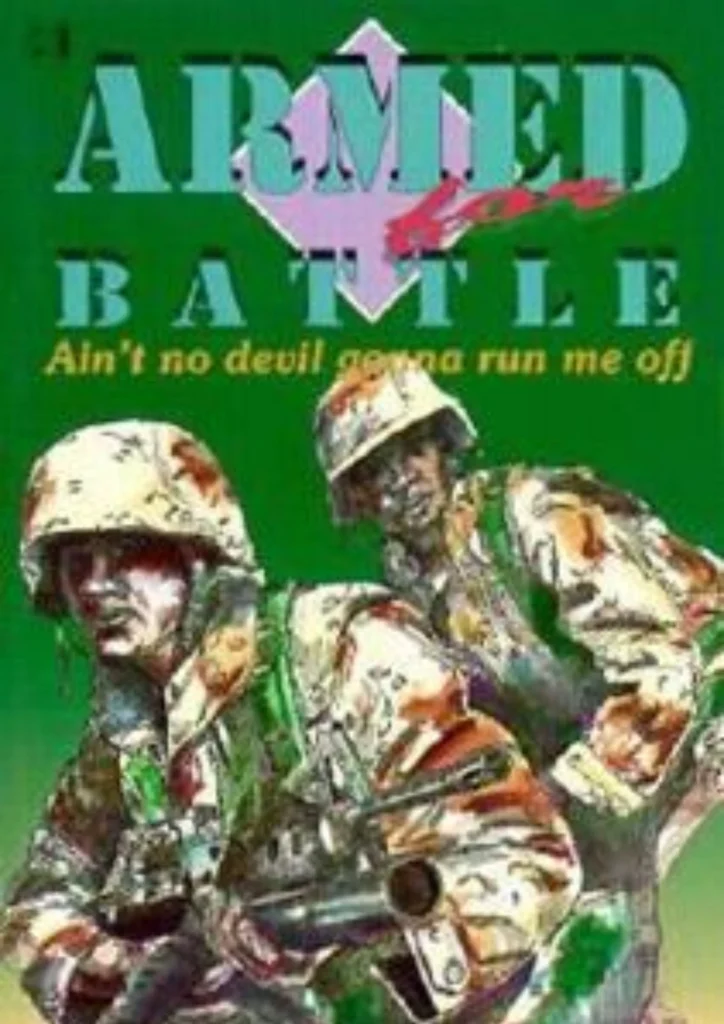
Armed for Battle Ain’t No Devil Video
Armed for Battle: Publication Details
Release Information and Publisher
Carlton Pearson’s zealous and authoritative handbook, “Armed for Battle Ain’t No Devil,” was released in the early 1990s. It came at the peak of Pearson’s stewardship as a leading bishop in the international Charismatic and Pentecostal movements. It was published when teaching on spiritual warfare was at the center and thrilling dimension of religion, and it became a timely and highly sought-after manual for believers. It is reflective of Pearson’s pre-Inclusion, classic theology and representative of his role as a spiritual general, training his followers in what he presented as an actual, day-to-day war.
Type: Book on Spiritual Warfare and Religion
This is a classic representative of the spiritual warfare genre, combined with faith theology and positive confession. It is no soft devotional book; it’s a militant, high-octane field guidebook for serious Christians. The book is strongly practical, designed to break out of theological abstractness and provide believers with effective strategies, prayers, and declarations to resist and overcome negative powers in their lives. It’s a spiritual warfare guidebook, predicated on the idea that God has blessed Christians with divine authority over evil spirits.
By Author Carlton D. Pearson
Carlton D. Pearson (1953-2023) authored this book as a celebrated and influential figure in traditional Christianity. As the lead pastor of the giant Higher Dimensions church and host of the powerhouse Azusa Conference, he was seen as the quintessence of victorious Christian living. He authorizes his writing from the position of tremendous authority, speaking out as a “bishop” in God’s army who had witnessed firsthand the potency of these spiritual principles. He talks with assuredness, charisma, and zeal, repeating the vigorous style of preaching that gained him television fame on Christian stations and a popular following numbering thousands.
A Review and Analysis of Armed for Battle
Critical Reception and Reader Impact
When initially released, Armed for Battle was warmly received by its target audience. It was hailed as a liberating and essential guidebook that presented straight, biblical answers for life’s daily skirmishes. Its readers were made to feel strong and empowered, having been given a new authority over matters like sickness, poverty, and depression, which the book redefined as spiritual attacks. The impact was huge; it gave people a tangible sense of control and an active way of practicing their faith.
Contemporary critical analysis, however, must be done in a context of dramatic irony. The book’s entire dualistic cosmology—a struggle within the universe between God and an omnipotent devil—is exactly the same system that Pearson himself would later completely dissolve with his “Gospel of Inclusion.” Effective when it was published, its teachings of a literal devil as the cause of all strife are opposed diametrically to his later, more non-dual and universalist theology.
Who is the Target Audience for this Book?
The target audience for this book is overwhelmingly clear-cut: Spirit-filled, Charismatic, and Pentecostal Christians who believe in the actual, supernatural reality of a spiritual realm. It is aimed at believers who feel that they are constantly trying and yearning for a straightforward, biblically-based approach to victory. It speaks to a reader who is comfortable with militant, imperative language and is open to learning the “rules of engagement” for spiritual conflict. It is not intended for the casual seeker but for the dedicated “Christian soldier” who is ready to go on the offensive.
The Core Thesis Within Armed for Battle
Unpacking the Central Message on Spiritual Victory
The general thesis of Armed for Battle Ain’t No Devil is that the Christian is not a victim of circumstance but has been supernaturally empowered and ordained by God to overwhelm, overcome, and dominate the devil and all demons. The very informal title is a summary of this thesis: a suitably “equipped” Christian who has divine information and weaponry does not need to be afraid or intimidated by the devil. Pearson’s main teaching is a revolutionary call to shift from a defensive posture of standing firm against suffering to an offensive posture of imposing the victory already won by Christ. Victory is not something to look forward to in the afterlife, it’s reality here and now to be seized.
A Summary of the Book’s Main Strategies
- Strategy 1: Know Your Enemy. Defines the devil as a real adversary whose strategies—lying, accusing, tempting—must be understood to be defeated.
- Strategy 2: Know Your Weapons. Outlines spiritual tools (“Armor of God”) including the Sword of the Spirit, Shield of Faith, and prayer, especially praying in tongues.
- Strategy 3: Know Your Authority. Emphasizes that believers themselves hold divine authority to command demons, rather than waiting for God to act.
- Strategy 4: Take the Offensive. Provides action steps: binding and loosing prayers, verbal declarations, and proactive spiritual practices to reclaim ground in family, finances, and health.
The Educational Value of Armed for Battle
Application in Theological and Pastoral Studies
For theology students, particularly in Pentecostalism or the history of the Charismatic movement courses, this book is a valuable primary source document. It superbly portrays the dualistic, supernatural worldview and the “dominion theology” that was so dominant in the late 20th century. It is a textbook example of a certain type of biblical interpretation (hermeneutics) and provides one with a necessary “before” photo for anyone tracking the theological trajectory of Carlton Pearson.
In pastoral theology, the book is a case study of this one model of pastoral counseling: the pastor as spiritual general. It describes a method of counseling that empowers individuals by extending their problems beyond themselves and providing them with a clear, structured, faith-based system for addressing them.
Discussion Topics for Students and Study Groups
- The Problem of Evil: How does Pearson’s explanation of suffering (as demonic attack) compare with theological theodicies?
- Psychology vs. Demonology: Where do modern psychology and spiritual warfare overlap or conflict (e.g., depression, addiction)?
- Rhetoric and Metaphor: How do the warfare terms and metaphors shape believers’ perception of reality and lived faith?
- Theological Evolution: Contrast this book’s militant dualism with Pearson’s later universalist theology. What propelled such a theological reversal?
Final Summary of Armed for Battle
Summary of Key Insights and Takeaways
- Believers are empowered, not weak: Faith grants agency and victory in daily struggles.
- Words are spiritually powerful: What believers confess verbally directly influences spiritual and physical reality.
- Authority has to be exercised: Spiritual authority requires active and vocal implementation.
- The supernatural world exists: The reality of spiritual forces is woven into daily Christian life and must be engaged practically.
Lasting Message of the Book
Armed for Battle Ain’t No Devil’s lasting message is one of empowerment through religion. While the specific theology in question can be argued, the central appeal of rejecting a victim mentality and of actively employing their faith to make an impact remains powerful. For Carlton Pearson’s students, this book is an absolutely essential read. It is a powerful, moving reminder of the fiery, orthodox world he once so vigorously defended. It’s a monument to a world vision that he would later deconstruct, so it’s a testament to the human capacity for radical religious transformation.